

LUCAS DONCHE
Volunteering Experience in Nepal
Week 1
My first week in Nepal felt like diving headfirst into a world entirely different from my daily life. It was a whirlwind of sensory experiences, cultural immersion, and new friendships that set the stage for an unforgettable journey.
A Warm, Chaotic Welcome
The moment I stepped out of the airport, I was greeted by the vibrant chaos of Kathmandu. A sea of taxi drivers immediately surrounded me, each eager to navigate me through the city’s bustling streets. However, the sense of belonging began the moment I met my driver from the association. From helping me exchange currency and set up a local SIM card to welcoming me into our volunteer house, he made me feel like part of the team before the work had even begun.
Festivals and Connections
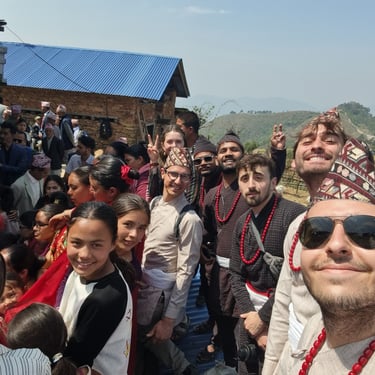
The following day, we were plunged into the heart of Nepali tradition. Celebrating the Nepali New Year in Bhaktapur was a masterclass in local culture—vibrant, loud, and deeply spiritual. Beyond the festivities, it was the perfect backdrop for us ESC (European Solidarity Corps) volunteers to bond. In those few hours of shared wonder, we laid the foundation for strong, lasting friendships.
Culture, Language, and Community
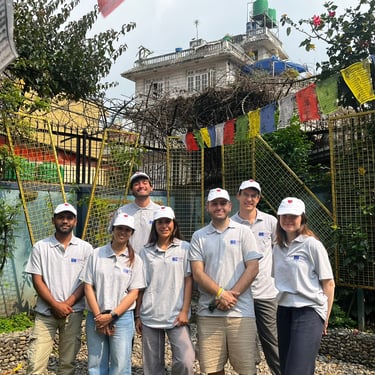
The next three days were dedicated to preparation. We began scratching the surface of Nepal's immense cultural diversity and grappled with the beautiful complexity of the Nepali language. We also spent time at the VIN (Volunteers Initiative Nepal) headquarters, learning about the impact of our upcoming work. Meeting the local Nepali volunteers was a highlight; their presence provided us with the support and insight needed to navigate this new environment.
Week 2
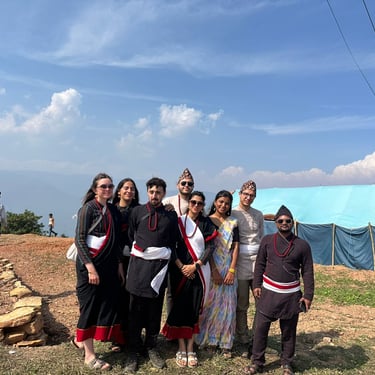
Week two began with us pretending to be highly organized professionals. We planned the children’s camps, split into two groups, and made big decisions like: “Who goes to CLC?” and “Who is emotionally ready for a 45-minute walk to a school?” (Spoiler: it’s never just 45 minutes. This is Nepal. Time works differently here.) But before any teaching began... we went to a wedding. And honestly? What a plot twist. It was completely different from anything I’d experienced before—in the best way possible.
The hospitality was incredible, the atmosphere was full of life, and the food? Absolutely the main character of the day. No shame. We all dressed in traditional outfits, which made us feel both fabulous and slightly unsure of how to sit, walk, or exist properly. Then came Tuesday. First day at the school.
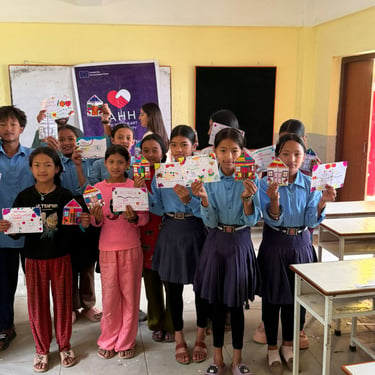
We walked in with a mix of excitement and “what are we actually doing?” energy. Big questions filled our minds: Will the kids come? Will they like us? Do we know what we’re doing? Well... yes and no. We had 25 kids in the classroom—which sounds like success. Except they were incredibly shy. And to make things more interesting, our carefully planned activity didn’t exactly break the ice.
Also, small confession: I was just as shy as they were. Not exactly the dream start. But hey—it was day one. No need to panic (yet).
That evening, back at “home,” we regrouped, rethought, and mildly questioned our life choices... before coming up with a much better plan.
And just like that—Wednesday saved us. Only 14 kids showed up, but honestly? Perfect. The vibe completely changed. Everyone was more relaxed, more open, and suddenly it felt less like a failed performance and more like an actual connection. From then on, everything just flowed.
One thing that really surprised me: their English level. These kids have a lot of vocabulary—like, impressive amounts. The only issue is figuring out how to use it. It’s like having all the puzzle pieces but not the picture on the box. And here’s the unexpected trick that worked: us trying to speak Nepali. Badly. The more we tried (and failed), the more engaged they became. Turns out, nothing builds connection faster than adults confidently mispronouncing words.
By the end of the week, it felt like we had found our rhythm. What started as a slightly awkward, quiet beginning turned into something fun, dynamic, and genuinely rewarding. So yes—week two had everything: planning, a wedding, mild chaos, personal growth, and 14 kids who slowly but surely stole the show.
Definitely entertaining. Definitely unpredictable. And definitely one for the books.
Week 3
This week was a completely different story from the last one. This time, the camp was held at CLC, which meant the kids came to us instead of us trekking to the school every morning. On paper, this sounded fantastic. No more long uphill walks. No more arriving already exhausted before the day had even started. A dream. But as it turns out, every blessing in Nepal comes with a plot twist. Because while we saved our legs... we lost any hope of controlling the environment. CLC is basically full of distractions for kids. Doors to open, rooms to explore, corners to disappear into—it’s like handing toddlers the keys to an amusement park and politely asking them to sit still for an English activity.
Unsurprisingly, this made focusing on our carefully planned activities... challenging. And by “challenging,” I mean occasionally feeling like we were trying to negotiate with a very small, very determined army. To make things even more interesting, these children were much younger than the ones we’d worked with at the school, and their English level was much lower. So not only were we trying to keep their attention, but we were also trying to explain activities using a combination of very basic words, exaggerated gestures, and what can only be described as professional-level charades.
Honestly, this week was tough. Part of the challenge is that at some point, the kids had clearly been given full access to every corner of CLC. They know how to open and close all the doors, they come and go as they please, and “boundaries” seem to be more of a creative suggestion than an actual rule. Which left us in the slightly awkward position of trying to establish limits from scratch. Not easy. Especially when the kids either don’t understand what you’re saying... or understand perfectly and simply choose chaos.
And then there were the older girls. Now, while we were enthusiastically preparing activities, they had their own priorities: taking photos in the garden and using the WiFi. Honestly? Respect. Their commitment to those goals was impressive. Still, despite all the challenges, we managed to carry out every activity we had planned. Sometimes smoothly. Sometimes with mild confusion.
Sometimes while mentally questioning every life decision that had led us to that exact moment. But we did it. And after surviving a week of tiny escape artists and dedicated WiFi seekers, we decided there was only one logical way to end it: A trekking trip to Pikey Peak. Because apparently, when volunteering gets exhausting, the natural response is to climb a mountain. Makes perfect sense.
Week 4
This week, our schedule required us to work in two different schools: two days in one school and two days in another. To begin with, I have to admit that I felt somewhat disappointed by the decision for two volunteers from our project to temporarily move to a different project during the first two days. We had all come here with the same shared purpose, and by that point, we were already used to working within our established teams. This change affected the group dynamic and made the week feel quite different from what we had experienced so far.
When we arrived at the first school, we quickly encountered another challenge: the teacherswere not particularly receptive to giving us time to carry out our planned activities. As it turned out, Monday and Tuesday coincided with local festival celebrations, which meant that very few children were attending school. Having this information in advance would have allowed us to adapt our plans and expectations accordingly.
On Wednesday, we moved to the second school, this time with the full team together again. Before beginning, the teachers informed us that we would only have one hour to work with the students. As a result, many of the activities we had carefully prepared could not be carried out as intended.
This experience raised important questions about the structure of the project. If many schools face difficulties allocating sufficient classroom time for these activities, it may be worth rethinking the format. I completely understand the schools’ perspective. Their academic schedules are already demanding, and interrupting lessons is not always feasible. However, this highlights the need to explore alternative solutions.
One possibility could be organizing the activities as extracurricular sessions, allowing students to participate voluntarily based on their interest. Another option might be to host events during weekends, with families and children informed in advance so they can attend without disrupting regular school hours. It is definitely something worth reflecting on for the future, as the goal is to create a structure that benefits both the schools and the impact of the project.
On Friday, we spent time catching up with the new volunteers who had recently arrived, sharing experiences and helping them settle in.
Then, on Saturday, we began the journey back to where it all started: Kathmandu. Returning to the city felt both familiar and surreal after everything we had experienced in Nishankhe. It offered a final moment to process everything that had happened over the past weeks.
On Sunday, it was time for my flight back to Spain. Leaving Nepal was emotional. In what felt like a very short time, this experience had become much more than a volunteering placement—it had become a journey of learning, reflection, adaptation, and personal growth. As I boarded the plane home, I carried with me not only unforgettable memories, but also valuable lessons about flexibility, teamwork, and the importance of continually adapting projects to better serve the communities they aim to support.
The Journey to Okhaldhunga
On the sixth day, the real adventure began. A grueling 10-hour drive took us away from the city and toward Okhaldhunga. We traveled through dusty, traffic-clogged roads that eventually gave way to roaring rivers and breathtaking mountain landscapes. Our destination was the Naratika Community Learning Center, a place we would call "home" for the next 20 days.
Silence and Reflection in Nishanke
After the long journey, we were gifted a day of rest to explore the village of Nishanke. Trekking through the surrounding hills, I found myself lost in the raw beauty of the Nepali wilderness. The silence of the forest, punctuated only by the distant mist clinging to the peaks, felt like an invitation to dream about the experiences yet to come.
As the sun set over the hills, I felt a deep sense of readiness. The introductions were over; the true work was about to begin.
LUCAS DONCHE
SUBSCRIBE
Subscribe to be updated about latest news and blog posts and to follow what is happening in a magical land of Bali.
Fatma Sümeyye Şahin
Çengelköy, Kalantor Sk. No:6 Üsküdar/İstanbul
Project Coordinator
Address
Telephone
+90 551 256 52 46